Your deck might look perfectly fine when you glance at it from the backyard. But what would a professional deck builder notice?
Probably a lot more than the color of the boards.
A deck is more than an outdoor entertaining space. It’s a structure designed to safely support your family, friends, furniture, grills, planters, and everything else you bring onto it. Over time, exposure to rain, snow, moisture, temperature changes, and everyday use can take a toll.
Here in West Michigan, decks experience everything from hot summer days to freezing temperatures, heavy snow, rain, and repeated freeze-thaw cycles. That makes routine deck maintenance—and knowing the warning signs of potential problems—especially important.
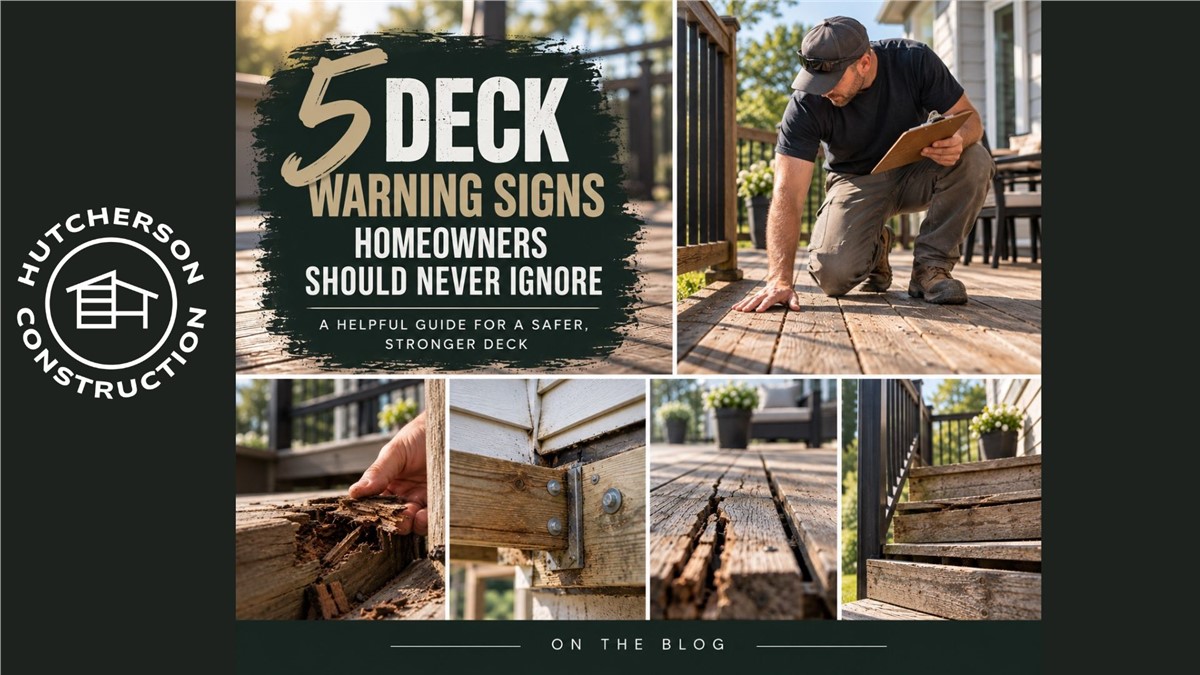
At Hutcherson Construction, there are several things our deck builders tend to notice immediately when looking at an existing deck.
Here are five deck warning signs homeowners shouldn't ignore.
1. Loose or Wobbly Deck Railings
Grab your deck railing and give it a gentle push.
Does it move?
A properly installed deck railing should feel secure. If the railing shakes, wobbles, or moves significantly when pressure is applied, it deserves a closer look.
A loose railing may be caused by issues such as:
- Loose fasteners or connections
- Deteriorating wood
- Aging materials
- Problems with railing posts
- Improper installation
- Damage around the railing connection points
This isn't simply a cosmetic problem.
Railings are an important safety feature, particularly on elevated decks. They need to withstand people leaning against them and provide support around stairs and deck edges.
If you've gotten used to a railing that "has always been a little wobbly," don't automatically assume it's normal.
Have it evaluated.
2. Rot, Soft Spots, or Crumbling Wood
Wood rot is one of the biggest things we're looking for when evaluating an older wood deck.
And it isn't always obvious.
A homeowner may notice one deteriorating board and assume that replacing the board will solve the problem. Sometimes it will.
Other times, the visible damage is only part of what's happening.
When checking a deck for signs of deterioration, pay particular attention to:
- Deck boards
- Posts
- Stair treads
- Stair stringers
- Joists and framing
- Areas around fasteners
- Areas where water collects
- Places where wood meets the house
- Areas that receive limited airflow or sunlight
Wood that feels unusually soft, spongy, flaky, or easily crumbles may indicate deterioration.
Moisture is especially important to consider. Water that repeatedly reaches an area without being able to drain or dry properly can contribute to deterioration over time.
That's why an experienced deck contractor isn't only looking at the surface boards.
We're interested in what's happening underneath them, too.
3. How Your Deck Is Attached to Your House
This is something many homeowners never think about.
For an attached deck, the connection between the deck and house is extremely important.
A key component of many attached decks is the ledger board. The ledger helps connect the deck structure to the home.
When evaluating this area, a deck professional may look at factors including:
- How the ledger is fastened
- The condition of the connection
- Flashing
- Signs of moisture intrusion
- Deteriorated wood
- Corrosion
- Gaps or movement
- Signs that the deck may be pulling away from the house
Why Is Deck Ledger Flashing Important?
Flashing helps direct water away from vulnerable areas where the deck connects to the home.
When water repeatedly gets behind or around the ledger connection, it can contribute to hidden deterioration.
And that's part of what makes water intrusion concerning: you may not immediately see what's happening behind the deck.
A deck can look relatively normal from above while problems develop in less-visible areas.
If you have an older attached deck and aren't sure how it was constructed, this is an area worth having professionally evaluated.
4. Cracking, Sagging, or Uneven Deck Boards
A cracked deck board doesn't automatically mean your entire deck needs to be replaced.
Individual boards can become damaged for a variety of reasons.
What deserves additional attention is when you begin noticing things such as:
- Multiple cracked boards
- Boards that feel unstable
- Sections of the deck that sag
- Uneven areas
- Large gaps
- Areas that feel unusually bouncy
- Boards lifting away from the framing
- Changes in the overall deck surface
The important question is why the surface is changing.
If the problem is limited to an individual board, the solution may be relatively straightforward.
If an entire area is sagging or moving, however, the cause may be underneath the decking.
The deck surface only tells part of the story.
That's why professional deck evaluations typically involve looking at the framing and supporting structure rather than judging the deck solely by what can be seen from above.
5. Loose, Uneven, or Questionable Deck Stairs
Deck stairs get a tremendous amount of use.
They also contain multiple components that need to work together properly.
When our deck builders look at stairs, we're paying attention to things like:
- Loose stair treads
- Uneven steps
- Deteriorating wood
- Shaky railings
- Movement
- Cracking
- Connections
- General stability
Sometimes you don't even need construction experience to recognize a potential issue.
You can feel it.
If you walk down your deck stairs and they bounce, shift, wobble, or simply don't feel solid underneath your feet, pay attention to that.
Stairs are an area where stability matters every single time someone enters or exits the deck.
Why Deck Safety Inspections Matter
The biggest reason to pay attention to these warning signs is simple:
Your deck needs to safely support the people using it.
It's easy to focus on how a deck looks.
Homeowners spend plenty of time thinking about decking colors, railing styles, furniture, lighting, landscaping, and outdoor kitchens.
Those things matter.
But before worrying about aesthetics, the structure itself needs to be evaluated.
A loose railing can present a fall hazard.
Rot can extend beyond what's immediately visible.
Water intrusion can contribute to hidden deterioration.
Sagging areas may indicate problems beneath the decking.
Unstable stairs can create unnecessary risk.
And an improperly secured deck connection deserves professional attention.
The good news is that spotting one of these warning signs doesn't automatically mean you need an entirely new deck.
Sometimes a problem can be repaired.
Other times, particularly with an older or significantly deteriorated deck, replacement may make more sense.
The important thing is determining what you're actually dealing with.
How Often Should You Check Your Deck?
Homeowners should make a habit of visually inspecting their deck regularly, particularly after winter or severe weather.
Spring is a great time to walk around your deck and look for changes that may have occurred during the colder months.
You can perform a basic homeowner deck check by looking for visible deterioration, gently checking railing stability, walking across the deck to notice unusual movement, examining stairs, and looking underneath the deck when possible.
Pay attention to anything that has changed.
Was that railing always loose?
Is that board suddenly soft?
Did that section always sag?
Are the stairs moving more than they did last summer?
Changes can be valuable clues.
If you notice something concerning—or simply aren't sure what you're looking at—bring in a professional.
Repair or Replace? What Should You Do With an Aging Deck?
This is one of the most common questions homeowners have.
Unfortunately, there isn't one answer that applies to every deck.
The decision to repair or replace a deck can depend on factors such as:
- Age of the deck
- Extent of deterioration
- Condition of the framing
- Condition of posts and footings
- Ledger connection
- Stair condition
- Railing condition
- Previous repairs
- Materials used
- Desired changes to the deck
- Long-term plans for the home
If the underlying structure is in good condition, repairing certain components may be an option.
If deterioration is widespread or the homeowner wants to significantly change the size, layout, materials, or functionality of the deck, replacement may make more sense.
A professional deck contractor can help evaluate the existing structure and discuss available options.
Considering a New Deck in West Michigan?
At Hutcherson Construction, we build outdoor spaces designed to look great while paying attention to the details homeowners may never see once construction is complete.
Whether you're concerned about an aging deck or dreaming about replacing it with a new composite or PVC deck, our team can help you determine the next step.
We work with homeowners throughout West Michigan on deck replacement and new deck projects, including options from TimberTech and AZEK, along with a variety of railing, stair, lighting, and design choices.
If your current deck has loose railings, soft spots, questionable stairs, sagging areas, or other signs that something isn't quite right, don't ignore it.
Sometimes the smallest visible problem is simply a repair.
Sometimes it's telling you to look a little deeper.
Ready to talk about your deck? Contact Hutcherson Construction to schedule a free estimate and start planning your outdoor space.
Tags
Subscribe to Hutcherson Construction's Blog



Comments